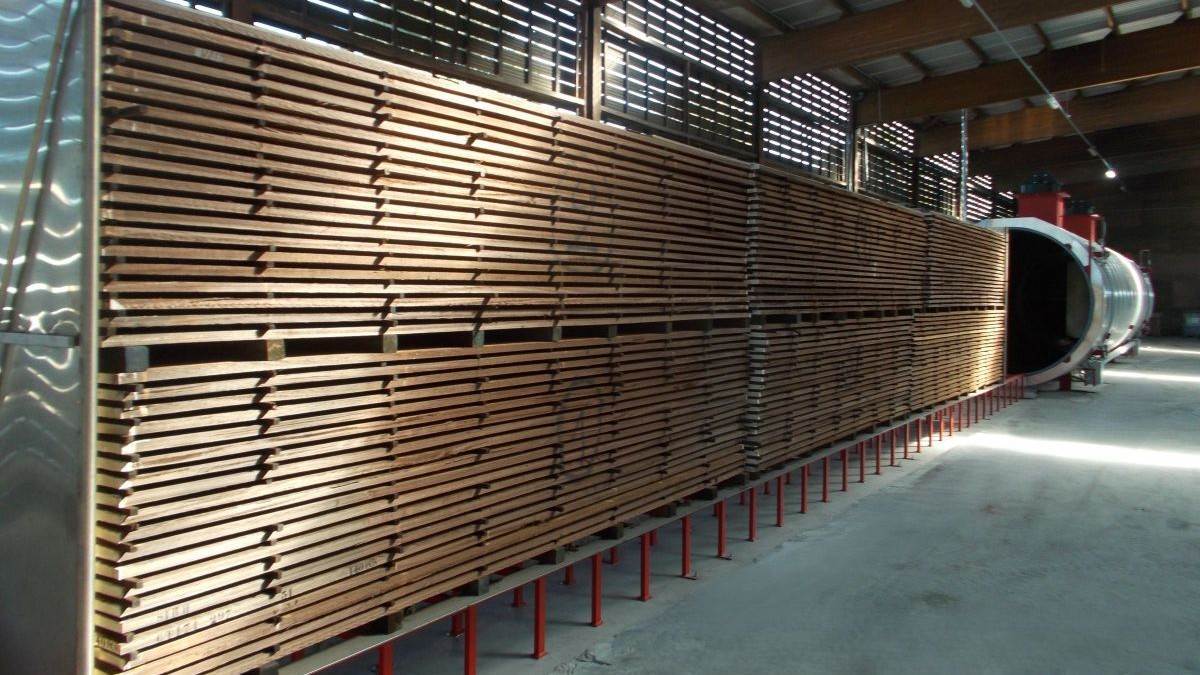
Wood Thermal Modification: How to Avoid Defects and Ensure Consistent Production Quality
14.10.26
Why Is Thermal Modification Quality More Important Than Ever?
Demand for thermally modified wood continues to grow across Europe and global markets. Facades, decking, windows, doors, garden furniture, and other high-value wood products are increasingly manufactured from thermally modified timber because it offers enhanced durability, dimensional stability, and a longer service life.
However, thermal modification is far more than simply heating wood to high temperatures. It is a complex industrial process where even small deviations can lead to significant financial losses. Poor temperature control, uneven heat distribution, or inaccurate process parameters can turn valuable timber into costly waste.
This is precisely why more manufacturers choose proven technologies such as the WDE Maspell Thermo Vacuum System (TVS).
What Happens During Wood Thermal Modification?
During thermal modification, wood is treated at temperatures ranging from approximately 180°C to 220°C under controlled conditions.
During the process:
Wood hygroscopicity is reduced;
Moisture absorption decreases;
Dimensional stability improves;
Resistance against fungi and biological decay increases;
A uniform colour develops throughout the entire cross-section.
These benefits can only be achieved when the process is accurately controlled.
The Most Common Thermal Modification Challenges
Many woodworking companies that invest in lower-cost technologies face production issues that are not always immediately visible.
1. Uneven Colour
If temperature distribution inside the chamber is inconsistent, some material may become excessively dark while other parts remain under-treated.
The result:
Inconsistent product appearance;
Customer complaints;
Additional sorting requirements;
Reduced sales value.
2. Cracks and Deformation
Excessively rapid heating or uncontrolled cooling creates internal stresses within the timber.
This may result in:
End checking;
Surface cracks;
Board warping;
Twisting;
Dimensional inaccuracies.
3. Internal Quality Damage
In some cases, the wood surface may appear acceptable while the internal structure has already been over-processed.
This can lead to:
Reduced mechanical strength;
Increased risk of breakage;
Quality issues during further processing.
4. Poor Process Repeatability
This is especially problematic for manufacturers supplying export markets.
When every production cycle produces different results:
Quality control becomes more difficult;
Production costs increase;
Customer confidence decreases.
How Expensive Can Production Defects Become?
Consider a thermal modification cycle processing 20 m³ of high-value pine or spruce.
Even a small percentage of:
Production waste;
Reprocessing requirements;
Colour inconsistencies;
Deformation-related losses
can cost thousands of euros per batch.
In many cases, the initial savings achieved by purchasing a cheaper thermal modification system later become far greater losses during production.
Why Does Vacuum Technology Offer Significant Advantages?
Conventional thermal modification systems typically use hot air or steam as the primary heat transfer medium. These methods may create temperature fluctuations and uneven treatment conditions.
The WDE Maspell Thermo Vacuum System (TVS) operates under vacuum conditions, providing:
More uniform temperature distribution;
More efficient heat transfer;
A gentler process for the wood structure;
Superior process control;
Higher and more consistent product quality.
As a result, manufacturers can achieve more homogeneous material while significantly reducing the risk of defects.
Why Do Professional Producers Choose WDE Maspell?
Patented Technology
WDE Maspell has specialized in vacuum technologies for wood drying and thermal modification for more than two decades.
High Process Repeatability
Manufacturers can rely on predictable and consistent results from cycle to cycle.
Remote Monitoring
PLC control systems allow operators to monitor processes in real time via computers, tablets, or smartphones.
Energy Efficiency
Optimized process management helps reduce energy consumption compared to many conventional systems.
Lower Risk of Defects
Precisely controlled processing parameters contribute to stable product quality and lower production losses.
The Future of Thermally Modified Wood in the Baltic Region
European markets increasingly demand sustainable wood products that require no chemical treatment. Thermally modified wood is becoming a preferred alternative to tropical hardwoods while maintaining excellent technical and aesthetic properties.
For this reason, selecting thermal modification technology is not merely a production decision but also a strategic business investment. Choosing a reliable and proven solution helps reduce production risks, improve product quality, and strengthen competitiveness in export markets.
WDE Maspell Thermal Modification Kilns in Latvia
KALTE.LV is the official representative of WDE Maspell in Latvia and the Baltic States. We help woodworking companies implement advanced Thermo Vacuum System (TVS) technology by providing equipment supply, installation, training, and technical support.
If your goal is to reduce waste, improve the quality of thermally modified wood, and achieve reliable production results, contact KALTE.LV today.
Atpakaļ